
Rotavators and cultivators tend to get most of the attention when people talk about farm mechanization, but they’re only part of a much larger toolkit. A well-equipped farm relies on a range of implements, each designed for a specific stage of the crop cycle — from breaking new ground to protecting crops as they grow. Here’s a look at some of the other essential implements that keep farms running efficiently.
Disc harrows
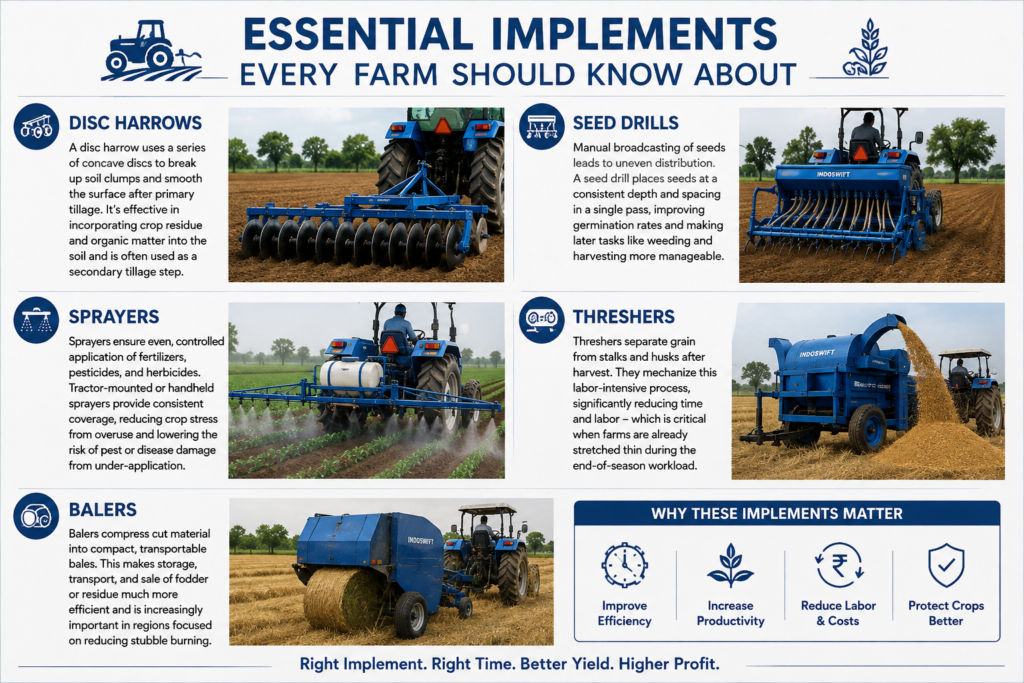
A disc harrow uses a series of concave discs to break up soil clumps and smooth the surface after primary tillage. It’s particularly effective at incorporating crop residue and organic matter into the soil, and it’s often used as a secondary tillage step to prepare a finer seedbed than a plough alone would leave behind. Disc harrows are especially valuable in fields with heavy stubble from the previous harvest.
Seed drills
Manual broadcasting of seeds is fast but inconsistent — seeds end up scattered unevenly, at varying depths, leading to patchy germination. A seed drill solves this by placing seeds at a consistent depth and spacing in a single pass, which directly improves germination rates and makes later tasks like weeding and harvesting more manageable, since crop rows are uniform and predictable.
Sprayers
Crop protection depends heavily on even, controlled application of fertilizers, pesticides, and herbicides — something that’s difficult to achieve manually without over- or under-applying in different areas. Sprayers, whether tractor-mounted or handheld, allow for consistent coverage, reducing both crop stress from overuse and the risk of pest or disease damage from under-application.
Threshers
Once crops are harvested, separating grain from stalks and husks is a labor-intensive process if done manually. Threshers mechanize this separation, dramatically reducing the time and labor needed after harvest — which matters most exactly when farms are already stretched thin managing the end-of-season workload.
Balers
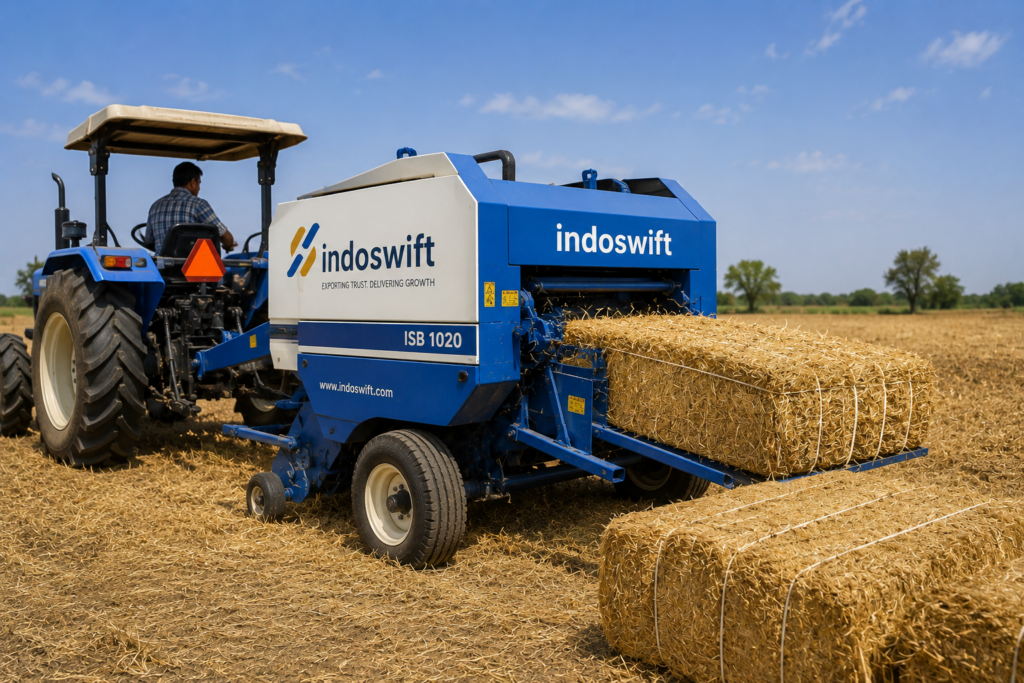
For farms growing fodder crops or dealing with large volumes of crop residue, balers compress cut material into compact, transportable bales. This makes storage, transport, and sale of fodder or residue significantly more efficient than handling loose material, and it’s increasingly relevant as demand for baled crop residue grows in regions focused on reducing stubble burning.
Why implement diversity matters
No single implement can handle every stage of farming effectively. Land preparation, sowing, crop protection, harvesting, and irrigation each demand tools built for that specific task — using the wrong implement, or skipping mechanization at a particular stage, often creates a bottleneck that undermines efficiency gained elsewhere in the process.
For farmers and dealers building out equipment inventory, thinking in terms of the full crop cycle — rather than just the most commonly discussed implements — leads to a more complete, more resilient farming operation.
Investing beyond the basics
As mechanization continues to expand across Indian agriculture, farms that invest in a broader range of well-built implements — not just the most talked-about ones — tend to see more consistent results across the full growing season. Quality matters as much here as it does with rotavators or cultivators: a poorly built seed drill or sprayer can undermine the efficiency gains mechanization is meant to deliver.
If you’re sourcing agricultural implements or components for your farm or business, Indo Swift Exports supplies quality-checked products built for reliable performance across different stages of the crop cycle. Get in touch with our team to discuss your requirements.
