
Not all soil behaves the same way under a rotavator, and not all blades are built to handle every kind of soil. Choosing the wrong blade type can mean poor tilling depth, faster wear, higher fuel consumption, and more time spent redoing work that should have been done right the first time. If you’re a farmer, dealer, or equipment buyer trying to match rotavator blades to field conditions, here’s what actually matters.Farming has come a long way from traditional hand tools and bullock-drawn ploughs. Today, agriculture stands at the crossroads of tradition and technology, where modern implements are helping farmers achieve more with less effort, less time, and better precision. Whether it’s a small landholding or a large commercial farm, the right set of agricultural implements can make the difference between an average harvest and an exceptional one.
Why blade selection depends on soil type
A rotavator blade’s job is to cut, lift, and mix soil in a single pass. Heavy clay soil resists cutting and clumps easily. Sandy soil is easier to cut but offers less traction and can cause blades to skip. Loamy soil sits somewhere in between and is generally the most forgiving. The blade’s shape, curvature, and cutting edge all affect how well it performs in each of these conditions — which is why “one blade fits all” rarely holds true in practice.
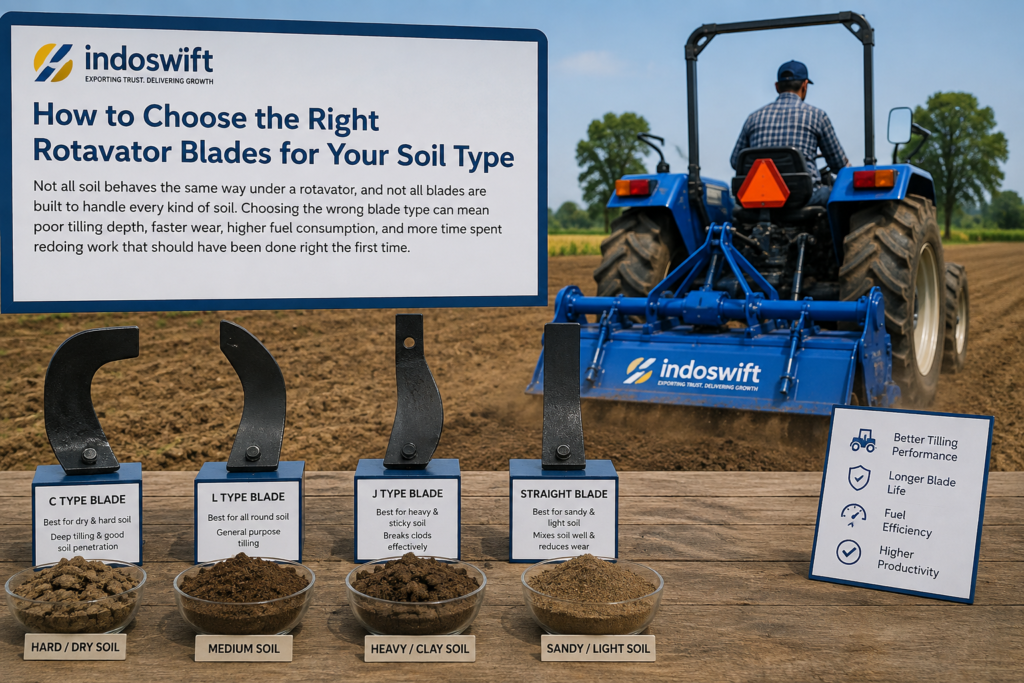
The main types of rotavator blades
L-shaped blades are the most common choice for general farming. They cut cleanly, handle a wide range of soil types reasonably well, and are relatively easy to maintain. For farmers working mixed or unpredictable soil across different plots, L-shaped blades are usually the safer default.
C-shaped (curved) blades are better suited to heavier, compacted, or clay-rich soil. Their curvature allows deeper penetration and better soil turnover, which helps break up dense clumps that L-shaped blades might struggle with. If your land tends to harden after rain or during dry spells, C-shaped blades are worth considering.
Y-shaped and specialty blades exist for specific applications like paddy fields, orchards, or soil with heavy root and stubble content. These are less common but important for niche use cases where standard blades wear out too quickly.
Matching blade choice to your soil
For light, sandy soil, prioritize blades with a sharper cutting angle and less aggressive curvature, since sandy soil doesn’t need as much force to till but benefits from precision to avoid over-tilling.
For heavy clay soil, curved or C-shaped blades with reinforced tips tend to perform better, as they can handle the extra resistance without bending or dulling quickly.
For loamy or mixed soil, standard L-shaped blades typically offer the best balance of durability, cost, and performance — which is also why they remain the most widely used option across Indian farms.
A quick checklist before you buy
- Identify your dominant soil type (sandy, clay, loamy, or mixed)
- Check blade curvature and cutting angle against your soil’s resistance level
- Confirm the steel grade and hardness rating
- Match blade dimensions to your rotavator’s specifications
- If buying in bulk, ask for consistent batch quality, not just a sample piece
